
Jon Snow (aka Ned Stark's bastard) (![[personal profile]](https://www.dreamwidth.org/img/silk/identity/user.png) nedstarksbastard) wrote2015-05-31 03:06 pm
nedstarksbastard) wrote2015-05-31 03:06 pm
nedstarksbastard) wrote2015-05-31 03:06 pm


![[community profile]](https://www.dreamwidth.org/img/silk/identity/community.png) ryslig app
ryslig app
OOC INFORMATION
Name: Effy
Contact:![[plurk.com profile]](https://plurk.com/favicon.ico) robbstark
robbstark
Other Characters: Marian "sets fire to things while punning" Hawke |doesnotjuggle
CHARACTER INFORMATION
Character Name: Jon"Ned Stark's bastard" Snow
Age: 16.
Canon: A Song of Ice and Fire
Canon Point: After Queenscrown in ASOS.
Character Information: Jon on AWOIAF.
Personality:
"You must be Ned Stark's bastard."
There, done.
...what the fuck do you mean I'm not done? What about this?
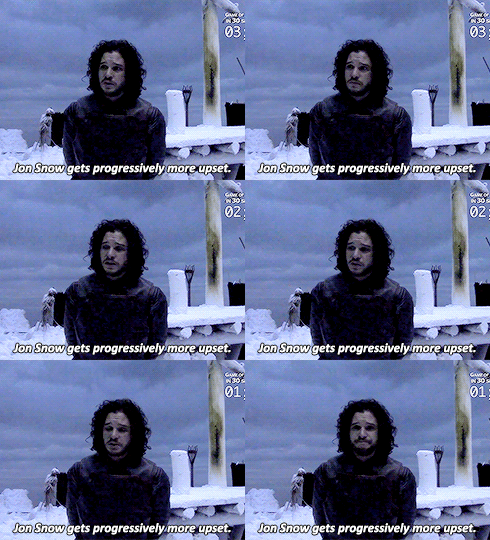
Okay, fine--no, I'm not really done there. Jon Snow is Ned Stark's bastard (disregarding certain popular theories in fandom)--that's kind of incredibly important to his character and personality. See, in Westeros, bastards are kind of stigmatized and looked down on, seen as lustful and deceitful, and often bastards grow up not knowing their true heritage. Just ask Robert Baratheon's gaggle of bastard children, only one of which knows who he was fathered by because Robert banged a noblewoman. Even if they do know, it's pretty uncommon for bastards to be folded into a noble family and raised alongside his trueborn half-siblings. Which is exactly what Ned Stark did with Jon here, something his lady wife Catelyn Tully did not like at all, from her rather cold treatment of Jon.
Being a bastard is entwined in Jon's character--growing up, it meant he would never inherit Winterfell, never truly be a part of the Starks the way his trueborn half-siblings were, always be on the outside looking in. It also meant he'd grow up faster and a lot more solemn than his trueborn siblings, with the need to prove himself somehow and earn his honor. Because of his status as a bastard, Jon's a little more flexible in how he views honor and the world than, say, Robb: while he values honor and the things his father taught him, he's been known to do some morally gray things in the series for the greater good--later on in his canon, for example, way after his current canon point, he swaps the infant child of the deceased wildling princess Dalla and the thought-dead King Beyond the Wall Mance Rayder with the infant of a wildling girl named Gilly before sending Gilly and his friend Sam (and the old Maester Aemon) off to Oldtown, in order to keep the red priestess Melisandre from burning either Aemon or Dalla's babe as a sacrifice of king's blood. He's also better at lying through his teeth--when he's first brought to Mance, he's tested by asking why he turned his cloak, and in reference to Mance's story about having joined up with Robert's entourage and observed Jon and his trueborn siblings in Winterfell during the feast in AGOT, gives this as an answer: "Did you see where I was seated? Did you see where they put the bastard?"
He's pretty reserved around people he doesn't know or trust, usually, coming off on occasion as emotionally distant and aloof at best and downright distrustful at worst. He's not one to let people in easily, and in his opinion, if you haven't earned his loyalty and respect, then he's not simply giving it to you straight off the bat. He can be somewhat suspicious and distrustful of others at times, especially if they're rather aggressive and bullying in their ways (see: Janos Slynt, Alliser Thorne, Rattleshirt), and can treat people somewhat roughly because of that--his first few days at the Wall did not go over too well, owing to the fact that he hated nearly everyone there and made no secret of it. He's blunt about his opinion of a person, calling Theon Greyjoy an ass in his first appearance and then going on to note to his little sister Arya that Joffrey "looks like a girl", and if pushed (say, by Janos Slynt insisting that Jon call him "my lord"), will give someone a lot of sass even when he really shouldn't ("I'll go, my lord. But you are making a mistake, my lord. You are sending the wrong man, my lord."). Even when he doesn't voice it, his thoughts can be brutally blunt about somebody--in the narration for his first chapter, he notes that the Princess Myrcella Baratheon is "insipid", which is a bit harsh, seriously, Jon, she's a baby, and he also views King Robert as "a great disappointment".
Jon is also pretty observant, something he attributes to growing up a bastard: "A bastard had to learn to notice things, to read the truth that people hid behind their eyes." Because he's been hanging out in the back all his life, he's developed a perceptiveness for other people, which contributes a bit to his general distrust of others--being observant and perceptive means he's fairly good at seeing through courtesies and false pleasantries, which is shown in his first POV chapter as well: he notes that "even at fourteen, he could see through [Cersei's] smile", and that his lord father "was observing all the courtesies, but there was a tightness in him that Jon had seldom seen before". Being fairly observant, though, also means that Jon's somewhat judgmental and suspicious, and though it's a habit he's managed to shake for the most part since heading to the Wall, there are times when it rears its ugly head up. Once he's judged somebody, it's hard to make him change his mind on them--but it is doable.
His need to prove himself and earn the honor and respect he wants leads him to decide to go to the Wall. At first it doesn't really go well--his image of the Wall and the Night's Watch is rapidly destroyed by the fact that his new brothers-in-arms are criminals and old men, and Jon's sullen and stubborn nature kicks in here. He doesn't get along with any of the other boys, and argues with his uncle Benjen when he finds out that Benjen's going on a ranging and begs to be taken along, only to be refused--even up until Benjen leaves, Jon's still trying to plead his case with him, which is a pretty good example of his stubborn nature: once he gets something into his head, he'll dig his heels in and refuse to give ground. Sometimes it's a good thing, as in the later chapters of ADWD, when he stubbornly refuses Stannis's offer of Winterfell and legitimization because, in his view, Winterfell belongs to his sister Sansa, and also in AGOT, when he convinces Maester Aemon to take Samwell Tarly on as his steward, using some very intelligent arguments. Sometimes it's not, as in AGOT (again), when he reacts rather badly to being assigned to the stewards--he should be a ranger, in his opinion, pointing out that he's "a better swordsman and a better rider than any of you" rather hotly, and only being dissuaded once his friend Sam points out that, as Lord Commander Mormont personally selected him, he's most likely being personally groomed for command.
Jon is loyal to the people he loves and cares for, and has an especially soft spot for fellow outsiders ("cripples, bastards, and broken things," as Tyrion Lannister puts it). Despite being an outsider all his life, and despite the fact that he really does want Winterfell--remember, he's a bastard, and Stannis's offer would have given him not only Winterfell, but recognition as a Stark--he puts his sister Sansa first, because she has more right to Winterfell than he does. He manages to make friends with two of the boys he bullied around when he first got to the Wall, and gives them, and the other recruits, support, advice and encouragement in training. When Samwell Tarly arrives, Jon leaps almost immediately to Sam's defense, even up against Alliser Thorne, the master-at-arms, who sends three other recruits up against him in retaliation--even then, Jon doesn't back down, thinking that he'll end up going to sleep bruised and bloody (though Pyp and Grenn save him from that fate). When he's around people he deeply, truly cares for, he lets his guard down and kids around with them, teases them a little, shows a warmer, softer side of him that he doesn't show to anyone else. He's more open to their opinions and ideas, more willing to listen to what they have to say and let their arguments sway him, and a lot likelier to do all that he can for them.
But sometimes Jon's loyalty to the people he loves conflicts with his duty as a brother of the Night's Watch. Given the chance, at least at first, he'll pick the people he loves over his duties, and damn the consequences, as seen when he rides off to join his brother's army in the middle of the night even if it means deserting his post, but the thing is, he's never given that chance. His friends and fellow black brothers ride out to stop him (successfully) and convince him to go back to the Wall, which he does in the end. A big part of Jon's character arc in the books is love vs duty and honor--love of family, love of a woman, love of something he wants. Aemon even spells it out for him: "What is honor compared to a woman's love? What is duty against the feel of a newborn son in your arms, or the memory of a brother's smile? Wind and words." Jon finds himself choosing between duty and love at least three times over the series, the aftermath of the second time being where he's coming from--the second time, he ends up riding away from Ygritte, the wildling woman he's fallen in love with, in order to warn his black brothers upon the Wall of the wildlings' impending attack, thus choosing duty over love. And that's the thing--Jon is dutiful, honorable at least in keeping to his vows as best as he can, even in extenuating circumstances and fully aware that being a man of the Night's Watch is a thankless job.
It's not easy, though, picking duty over love. Jon finds himself deeply in conflict about that a lot of times, especially during his time undercover amongst the wildlings. Qhorin Halfhand commands him to watch them, to ride with them and eat with them and fight with them, to not balk at whatever they ask of him, and that's precisely what Jon does: watch, and spy, and wait. At least that's what he plans to do, and he tries his best to keep himself emotionally distant from the wildlings he rides with, especially Ygritte, only they manage to worm their way into his heart regardless of his efforts, especially Ygritte. He finds himself growing to like the wildlings, even as he plans to betray them, and especially growing closer to Ygritte, who he develops feelings for and then, later on, gets to know more intimately. Which is not a good thing, in his opinion, as his vows prevent him from taking a wife and he really did try to keep to the spirit of the words, and he really, deeply, truly cares for her, to the point where she ends up being mentioned a lot in his POV chapters in ADWD after her death and he takes a lot of her lessons (and her frequent use of the sentence "You know nothing, Jon Snow") to heart. At the same time, though, he ends up going back to the Wall anyway--a huge change from the boy who'd ridden off to try and join his brother's army when he heard the news, and as it turns out, one beneficial for the Wall and the realm itself.
Not that Jon is going to find that out for a while, thanks Ryslig.
5-10 Key Character Traits:
- dutiful
- loyal
- reserved
- observant
- compassionate
- suspicious
- conflicted
- distrustful
- solemn
- stubborn
Would you prefer a monster that FITS your character’s personality, CONFLICTS with it, or EITHER? something that fits!
Opt-Outs: Gargoyle, arachne, naga.
Roleplay Sample:
Jon on the TDM
Name: Effy
Contact:
Other Characters: Marian "sets fire to things while punning" Hawke |
doesnotjuggleCHARACTER INFORMATION
Character Name: Jon
Age: 16.
Canon: A Song of Ice and Fire
Canon Point: After Queenscrown in ASOS.
Character Information: Jon on AWOIAF.
Personality:
"You must be Ned Stark's bastard."
There, done.
...what the fuck do you mean I'm not done? What about this?
Okay, fine--no, I'm not really done there. Jon Snow is Ned Stark's bastard (disregarding certain popular theories in fandom)--that's kind of incredibly important to his character and personality. See, in Westeros, bastards are kind of stigmatized and looked down on, seen as lustful and deceitful, and often bastards grow up not knowing their true heritage. Just ask Robert Baratheon's gaggle of bastard children, only one of which knows who he was fathered by because Robert banged a noblewoman. Even if they do know, it's pretty uncommon for bastards to be folded into a noble family and raised alongside his trueborn half-siblings. Which is exactly what Ned Stark did with Jon here, something his lady wife Catelyn Tully did not like at all, from her rather cold treatment of Jon.
Being a bastard is entwined in Jon's character--growing up, it meant he would never inherit Winterfell, never truly be a part of the Starks the way his trueborn half-siblings were, always be on the outside looking in. It also meant he'd grow up faster and a lot more solemn than his trueborn siblings, with the need to prove himself somehow and earn his honor. Because of his status as a bastard, Jon's a little more flexible in how he views honor and the world than, say, Robb: while he values honor and the things his father taught him, he's been known to do some morally gray things in the series for the greater good--later on in his canon, for example, way after his current canon point, he swaps the infant child of the deceased wildling princess Dalla and the thought-dead King Beyond the Wall Mance Rayder with the infant of a wildling girl named Gilly before sending Gilly and his friend Sam (and the old Maester Aemon) off to Oldtown, in order to keep the red priestess Melisandre from burning either Aemon or Dalla's babe as a sacrifice of king's blood. He's also better at lying through his teeth--when he's first brought to Mance, he's tested by asking why he turned his cloak, and in reference to Mance's story about having joined up with Robert's entourage and observed Jon and his trueborn siblings in Winterfell during the feast in AGOT, gives this as an answer: "Did you see where I was seated? Did you see where they put the bastard?"
He's pretty reserved around people he doesn't know or trust, usually, coming off on occasion as emotionally distant and aloof at best and downright distrustful at worst. He's not one to let people in easily, and in his opinion, if you haven't earned his loyalty and respect, then he's not simply giving it to you straight off the bat. He can be somewhat suspicious and distrustful of others at times, especially if they're rather aggressive and bullying in their ways (see: Janos Slynt, Alliser Thorne, Rattleshirt), and can treat people somewhat roughly because of that--his first few days at the Wall did not go over too well, owing to the fact that he hated nearly everyone there and made no secret of it. He's blunt about his opinion of a person, calling Theon Greyjoy an ass in his first appearance and then going on to note to his little sister Arya that Joffrey "looks like a girl", and if pushed (say, by Janos Slynt insisting that Jon call him "my lord"), will give someone a lot of sass even when he really shouldn't ("I'll go, my lord. But you are making a mistake, my lord. You are sending the wrong man, my lord."). Even when he doesn't voice it, his thoughts can be brutally blunt about somebody--in the narration for his first chapter, he notes that the Princess Myrcella Baratheon is "insipid", which is a bit harsh, seriously, Jon, she's a baby, and he also views King Robert as "a great disappointment".
Jon is also pretty observant, something he attributes to growing up a bastard: "A bastard had to learn to notice things, to read the truth that people hid behind their eyes." Because he's been hanging out in the back all his life, he's developed a perceptiveness for other people, which contributes a bit to his general distrust of others--being observant and perceptive means he's fairly good at seeing through courtesies and false pleasantries, which is shown in his first POV chapter as well: he notes that "even at fourteen, he could see through [Cersei's] smile", and that his lord father "was observing all the courtesies, but there was a tightness in him that Jon had seldom seen before". Being fairly observant, though, also means that Jon's somewhat judgmental and suspicious, and though it's a habit he's managed to shake for the most part since heading to the Wall, there are times when it rears its ugly head up. Once he's judged somebody, it's hard to make him change his mind on them--but it is doable.
His need to prove himself and earn the honor and respect he wants leads him to decide to go to the Wall. At first it doesn't really go well--his image of the Wall and the Night's Watch is rapidly destroyed by the fact that his new brothers-in-arms are criminals and old men, and Jon's sullen and stubborn nature kicks in here. He doesn't get along with any of the other boys, and argues with his uncle Benjen when he finds out that Benjen's going on a ranging and begs to be taken along, only to be refused--even up until Benjen leaves, Jon's still trying to plead his case with him, which is a pretty good example of his stubborn nature: once he gets something into his head, he'll dig his heels in and refuse to give ground. Sometimes it's a good thing, as in the later chapters of ADWD, when he stubbornly refuses Stannis's offer of Winterfell and legitimization because, in his view, Winterfell belongs to his sister Sansa, and also in AGOT, when he convinces Maester Aemon to take Samwell Tarly on as his steward, using some very intelligent arguments. Sometimes it's not, as in AGOT (again), when he reacts rather badly to being assigned to the stewards--he should be a ranger, in his opinion, pointing out that he's "a better swordsman and a better rider than any of you" rather hotly, and only being dissuaded once his friend Sam points out that, as Lord Commander Mormont personally selected him, he's most likely being personally groomed for command.
Jon is loyal to the people he loves and cares for, and has an especially soft spot for fellow outsiders ("cripples, bastards, and broken things," as Tyrion Lannister puts it). Despite being an outsider all his life, and despite the fact that he really does want Winterfell--remember, he's a bastard, and Stannis's offer would have given him not only Winterfell, but recognition as a Stark--he puts his sister Sansa first, because she has more right to Winterfell than he does. He manages to make friends with two of the boys he bullied around when he first got to the Wall, and gives them, and the other recruits, support, advice and encouragement in training. When Samwell Tarly arrives, Jon leaps almost immediately to Sam's defense, even up against Alliser Thorne, the master-at-arms, who sends three other recruits up against him in retaliation--even then, Jon doesn't back down, thinking that he'll end up going to sleep bruised and bloody (though Pyp and Grenn save him from that fate). When he's around people he deeply, truly cares for, he lets his guard down and kids around with them, teases them a little, shows a warmer, softer side of him that he doesn't show to anyone else. He's more open to their opinions and ideas, more willing to listen to what they have to say and let their arguments sway him, and a lot likelier to do all that he can for them.
But sometimes Jon's loyalty to the people he loves conflicts with his duty as a brother of the Night's Watch. Given the chance, at least at first, he'll pick the people he loves over his duties, and damn the consequences, as seen when he rides off to join his brother's army in the middle of the night even if it means deserting his post, but the thing is, he's never given that chance. His friends and fellow black brothers ride out to stop him (successfully) and convince him to go back to the Wall, which he does in the end. A big part of Jon's character arc in the books is love vs duty and honor--love of family, love of a woman, love of something he wants. Aemon even spells it out for him: "What is honor compared to a woman's love? What is duty against the feel of a newborn son in your arms, or the memory of a brother's smile? Wind and words." Jon finds himself choosing between duty and love at least three times over the series, the aftermath of the second time being where he's coming from--the second time, he ends up riding away from Ygritte, the wildling woman he's fallen in love with, in order to warn his black brothers upon the Wall of the wildlings' impending attack, thus choosing duty over love. And that's the thing--Jon is dutiful, honorable at least in keeping to his vows as best as he can, even in extenuating circumstances and fully aware that being a man of the Night's Watch is a thankless job.
It's not easy, though, picking duty over love. Jon finds himself deeply in conflict about that a lot of times, especially during his time undercover amongst the wildlings. Qhorin Halfhand commands him to watch them, to ride with them and eat with them and fight with them, to not balk at whatever they ask of him, and that's precisely what Jon does: watch, and spy, and wait. At least that's what he plans to do, and he tries his best to keep himself emotionally distant from the wildlings he rides with, especially Ygritte, only they manage to worm their way into his heart regardless of his efforts, especially Ygritte. He finds himself growing to like the wildlings, even as he plans to betray them, and especially growing closer to Ygritte, who he develops feelings for and then, later on, gets to know more intimately. Which is not a good thing, in his opinion, as his vows prevent him from taking a wife and he really did try to keep to the spirit of the words, and he really, deeply, truly cares for her, to the point where she ends up being mentioned a lot in his POV chapters in ADWD after her death and he takes a lot of her lessons (and her frequent use of the sentence "You know nothing, Jon Snow") to heart. At the same time, though, he ends up going back to the Wall anyway--a huge change from the boy who'd ridden off to try and join his brother's army when he heard the news, and as it turns out, one beneficial for the Wall and the realm itself.
Not that Jon is going to find that out for a while, thanks Ryslig.
5-10 Key Character Traits:
- dutiful
- loyal
- reserved
- observant
- compassionate
- suspicious
- conflicted
- distrustful
- solemn
- stubborn
Would you prefer a monster that FITS your character’s personality, CONFLICTS with it, or EITHER? something that fits!
Opt-Outs: Gargoyle, arachne, naga.
Roleplay Sample:
Jon on the TDM